CLASS 1 OF 5
The First 10 Seconds
The Psychology of First Impressions and Guest Perception
12-15 minutesFirst impressions in hospitality are not opinions. They are neurological events. Research in behavioral psychology shows that guests form lasting judgments within seconds of arrival, and those judgments influence every interaction that follows. This class explores the science behind snap perception and gives hospitality professionals a framework for controlling those critical opening moments.

You never get a second chance at the first 10 seconds.
Guest perception begins before a word is spoken. Posture, eye contact, spatial awareness, and timing all send signals that the brain processes instantly. Understanding this science is the first step toward mastering it.
Why the First 10 Seconds Define the Entire Experience
Every guest interaction begins with a silent evaluation. Before a greeting is delivered, before a menu is presented, before a room key is handed over, the guest has already made a judgment. That judgment is not rational. It is instinctive, fast, and remarkably durable. Psychologists call it thin-slicing, the human ability to draw meaningful conclusions from very brief exposures to new information. In hospitality, those brief exposures happen at the front door, at the host stand, at the lobby threshold, at the check-in counter. The professionals who understand this have an enormous advantage. They do not leave first impressions to chance. They engineer them.

The Neuroscience of Snap Judgment
Princeton researchers Janine Willis and Alexander Todorov demonstrated that humans form reliable judgments about trustworthiness, competence, and likability within 100 milliseconds of seeing a new face. One tenth of a second. In a hospitality context, this means a guest's perception of your property's service quality begins forming the instant they see the first team member. That perception is not based on what you say. It is based on what they see: your posture, your facial expression, whether your eyes are engaged or distant, whether your body is oriented toward them or turned away.
This is not a metaphor. The amygdala, the brain's threat and reward processing center, evaluates faces and body language before the conscious mind has time to form a thought. A warm, open expression triggers a neurological green light. A distracted or closed expression triggers caution. The guest may not be able to articulate why they feel welcomed or unwelcomed, but the feeling is already locked in. Every interaction that follows is filtered through that initial impression. Psychologists call this confirmation bias. The guest will unconsciously seek evidence that supports what they already believe about your service.
The Three Signals That Matter Most
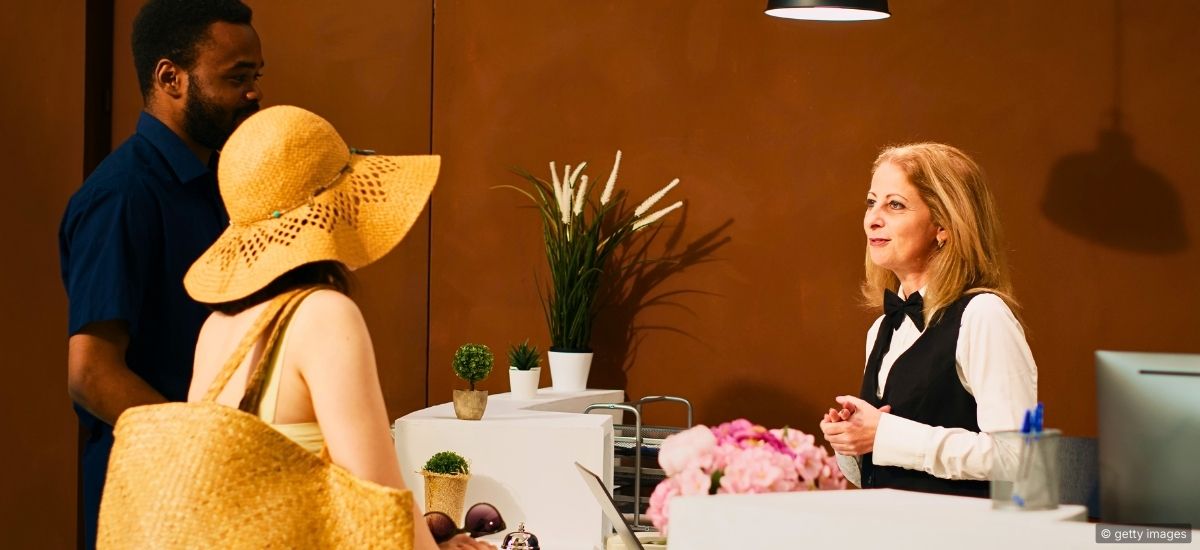
Decades of hospitality research and behavioral science converge on three nonverbal signals that carry the most weight in those opening seconds. The first is eye contact. Direct, unhurried eye contact communicates recognition. It tells the guest they have been seen, that they matter, that someone is paying attention. The second is physical orientation. Turning your body fully toward a guest, even before speaking, signals that they are the priority. Angled or side-facing posture, even unintentionally, communicates divided attention. The third is timing. The gap between a guest entering your space and receiving acknowledgment is measured in seconds, but it feels much longer to the guest. Industry leaders like the Ritz-Carlton have codified this into standards. Their team members are trained to make eye contact and smile within 10 feet and offer a verbal greeting within 5 feet.
These three signals work together as a system. Eye contact without orientation feels performative. Orientation without timely acknowledgment feels passive. A fast greeting without eye contact feels robotic. When all three are present and synchronized, the guest receives a single, unified message: you are expected, you are welcome, and we are ready. This is not personality. It is technique. It can be trained, measured, and reinforced. The most consistent luxury properties in the world do not rely on their team members having naturally warm dispositions. They build systems that produce warm interactions regardless of who is working. Platforms like Restaurant Standards help restaurant teams codify these exact behaviors into repeatable, trackable standards so that every shift opens with the same level of precision.
Engineering the Moment
Understanding the psychology is only half the equation. The other half is environment design. The physical space a guest enters shapes their perception just as powerfully as the person greeting them. Lighting, sightlines, sound levels, and spatial flow all contribute to the unconscious evaluation happening in those first seconds. A cluttered host stand communicates disorganization. A dimly lit entrance without a visible team member communicates indifference. A clear sightline from the door to a composed, attentive professional communicates control and care. The best operators audit their arrival experience regularly, walking the path a guest walks, seeing what a guest sees, and identifying friction points that undermine the impression they want to create.
This extends to digital first impressions as well. A guest who books online, receives a confirmation email, and arrives at the property has already had multiple touchpoints before they walk through the door. Each one contributes to the expectation they carry into that first in-person moment. If the digital experience was polished and personal, the bar is set high. If the in-person greeting falls short of that standard, the disconnect creates disappointment. Consistency across every touchpoint is what separates properties that deliver reliably excellent experiences from those that occasionally get it right. The first 10 seconds are not an isolated event. They are the culmination of every impression that came before them.
In Conclusion
The first 10 seconds of a guest interaction are not a soft skill. They are a strategic discipline rooted in neuroscience and perfected through deliberate practice. Guests do not decide how they feel about your property after the meal, after the stay, or after checkout. They decide in the opening moments and spend the rest of the experience confirming that decision. Hospitality professionals who understand this do not wait for guests to feel welcome. They create the conditions that make it inevitable. For restaurant teams ready to turn this knowledge into daily execution, Restaurant Standards provides the framework to make these moments consistent, measurable, and permanent.
Key Takeaways
- Guests form lasting judgments within 100 milliseconds based on nonverbal cues, not words
- Eye contact, physical orientation, and timing are the three signals that carry the most weight
- First impressions create confirmation bias that filters every interaction that follows
- Consistent systems outperform individual personality in delivering reliable first impressions
- The physical environment shapes guest perception as powerfully as the people in it, and tools like Restaurant Standards help teams maintain that standard across every shift
Perception is not what happens to the guest. It is what the guest decides happened.